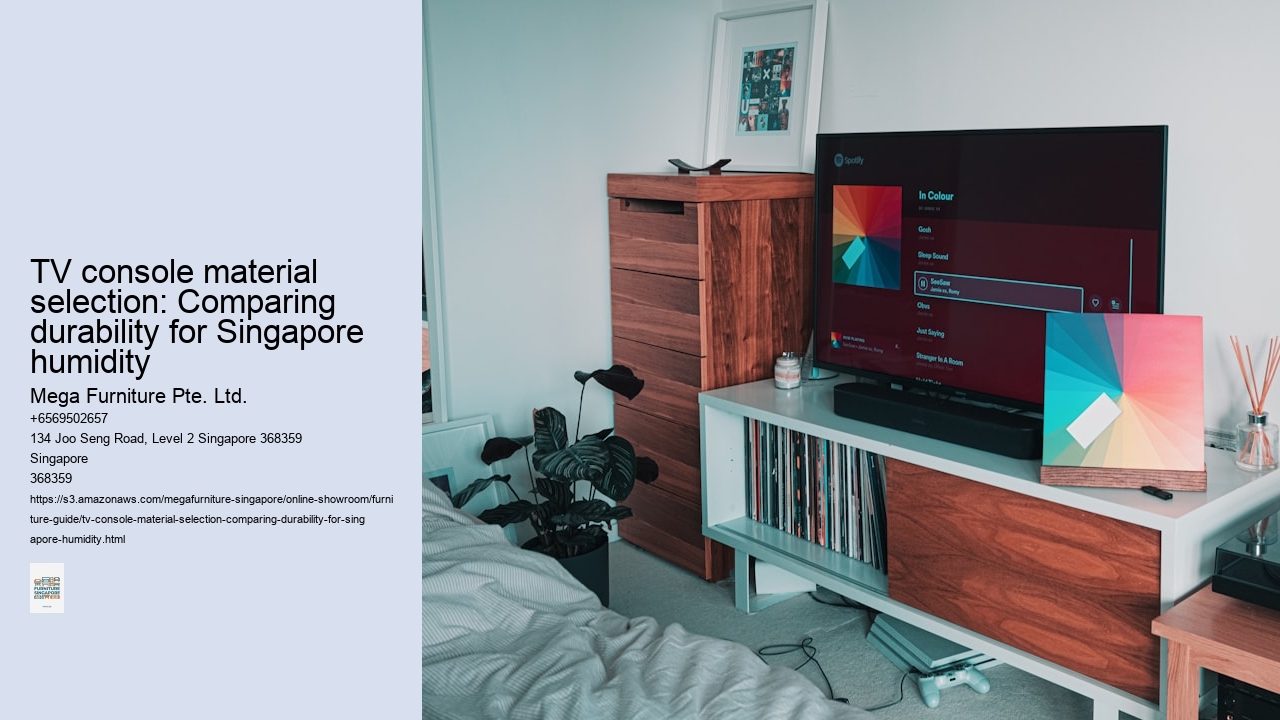
The typical BTO living room’s width is just under three metres—once you account for the walkway behind the sofa, that leaves a console length of around 180cm before it starts to feel like a corridor. A deeper unit, say 45cm instead of 35cm, might offer more storage for board games or a soundbar, but it’ll also shave precious centimetres off your circulation space. That’s why many flat owners stick to slimmer, floating designs; they keep the floor clear and trick the eye into seeing more room.
Condos with dedicated media walls present a different puzzle. Here, the console isn’t a standalone piece but an integrated component of built-in carpentry, often spanning from 200 to 240cm to align with flanking storage units. The depth is usually dictated by the carpentry framework, typically a standard 60cm to accommodate deep AV equipment and conceal a tangle of cables and routers. This seamless, wall-to-wall look is a favourite for creating a clean, organised centre of focus.
It’s a simple rule that’s often overlooked: your console’s length should relate directly to your TV size, but its depth is wholly determined by your room’s geometry. A 75-inch TV demands a console at least 180cm long for visual balance, but plonking a deep, floor-standing unit like that in a narrow HDB layout can make the whole wall feel imposing. The walking path from the main door to the kitchen shouldn’t become an obstacle course.
For those in tighter spaces, a wall-mounted or floating console around 30–35cm deep can be a saviour. It provides a necessary ledge for essentials—the set-top box, a gaming console—without claiming too much visual real estate. You’ll find options that manage this trick, offering clever cable management behind a slender profile.
Ultimately, the most durable material won’t matter if the proportions are wrong. Measuring your available wall space, not just the TV’s width, is the non-negotiable first step—before you even consider finishes or drawer configurations.
Solid teak handles Bukit Timah's humidity without warping, but it's a commitment. You'll need to oil it annually to prevent the rich colour from greying under constant air-con and afternoon sun glare. That oiling ritual, while satisfying for some, feels like a chore in a fourth-floor HDB where balcony space is scarce. Its weight also makes repositioning a 180cm console for Deepavali cleaning a two-person job. Still, for a family room facing west, that density absorbs knocks from toys and vacuum cleaners without showing a mark.
Spilled teh tarik wipes right off a high-pressure laminate without a trace. Modern matte and textured finishes convincingly mimic wood or concrete, resisting the scratches that come from sliding game consoles and router boxes in and out. They won't fade in sun-drenched condo living rooms, but the chip is the risk—a corner impact from a misjudged move reveals the substrate underneath. For most households, that's a fair trade for a finish that looks consistent from Tampines to Tanglin and requires only a damp cloth.
This is the pragmatic choice for a 4-room BTO's compact living room. The moisture-resistant composite core stabilises the structure against our climate's swings, preventing the seasonal expansion you get with solid wood. A quality engineered wood console can span 220cm for a 65-inch TV without sagging in the centre. Just ensure the veneer is properly bonded; a poor glue job near a humidifier will show as a bubbled edge within a year.
Thin wood veneers over particle board are a gamble in unventilated spaces. That sleek media wall niche in a resale flat, if it lacks airflow, becomes a trap for moist air that slowly delaminates the decorative surface. The peel usually starts at the back, hidden from view, before the edges lift near your subwoofer. It's a slow-motion disappointment, especially when you've paid for a specific grain pattern that's now permanently damaged.
Consider the traffic pattern. A console in a central walk-through space endures bag knocks, toddler handprints, and legged pet traffic. A textured, medium-toned laminate or a solid wood with a hardwax oil finish hides this micro-abrasion best. Glossy finishes, while easy to clean, highlight every fingerprint and dust streak from the corridor lift lobby. Your maintenance tolerance dictates the material more than anything—some buyers love the story of accumulating marks, while others want it to look factory-fresh for its entire lifespan.
The most obvious mistake is usually the last one made, after the boxes are unpacked and the console is finally in place. That’s when you realise the sleek, dark walnut veneer you chose shows every speck of dust and every fingerprint from the toddler — a daily maintenance commitment many underestimate in Singapore’s humid, particle-filled air. Lighter finishes, like oak or light grey laminates, are far more forgiving; they hide the fine layer of grime that settles in a week, especially in ground-floor units near main roads in neighbourhoods like Bedok or Tampines.
Cable management is another frequent oversight, particularly with the typical stack of a StarHub set-top box, a PlayStation, and a soundbar. Buyers focus on the console’s exterior dimensions, forgetting to check if the rear panel has proper grommets or channels to thread a dozen cables through neatly. The result is a tangled nest visible from the side, defeating the purpose of a storage console meant to conceal clutter. It’s a practical flaw that turns a design centrepiece into an eyesore.
Then there’s the issue of elevation, a critical consideration for resale flats. Installing a long, floor-standing console in a ground-floor unit, especially in older estates with dated drainage, is asking for trouble during our intense monsoon seasons. A sudden downpour can lead to flash floods that seep under the door, and that beautiful solid wood or MDF base will wick moisture up instantly. For such spaces, a wall-mounted or a floating console with legs that lift the body 15cm off the ground isn’t just an aesthetic choice — it’s a necessary defence against warping and mould.
Finally, there’s a stubborn tendency to prioritise length over proportion, cramming a 240cm monolith into a modest 4-room BTO living room just because the TV is 75 inches. The console shouldn’t dwarf the space; it needs breathing room on either side. A better rule is to leave at least 30cm of wall space free at each end, which often means opting for a 180cm console instead. That bit of empty wall makes the room feel organised, not overcrowded.
You can find a range of sizes and sensible, elevated designs suited to local conditions by browsing the TV console collection at Megafurniture.
A console that looks perfect in the showroom can start groaning under a 65-inch OLED within months in your Ang Mo Kio flat. The culprit’s often a flimsy back panel that warps in our humidity, letting the entire structure rack sideways — a slow-motion collapse you’ll notice every time a drawer sticks. That anti-warp backing isn’t just marketing; it’s a rigid, often composite or reinforced board that counteracts the pull of Singapore’s constant 80% humidity, keeping the carcass square. Check for it by tapping the back; it should feel solid, not like a thin sheet of cardboard that flexes.
Drawer action tells you everything about hidden build quality. Full-extension glides, where the drawer box pulls completely clear of the cabinet, are non-negotiable for accessing media gear stuffed at the back. They run on robust metal runners, not plastic wheels, and should glide out with a consistent, weighted feel — no sudden drops or shaky wobbles. Test them in the showroom with a firm push; cheap runners rattle and feel insubstantial, while quality ones have a dampened, self-closing finish.
For the console itself, adjustable feet are a simple lifesaver for HDB flooring. Even in newer BTOs, floors are rarely perfectly level, and a four-legged unit will rock on a high spot, stressing joints. Screw-adjustable feet let you stabilise it completely, eliminating that tell-tale wobble before you even load it up. It’s a small feature that prevents big problems, like doors that won’t align after a year.
Weight distribution becomes critical with wall-mounted or floating consoles, especially for units over 180cm holding today’s larger TVs. The mounting system must be designed to transfer that sheer load — a 55-inch TV plus soundbar can easily exceed 30kg — directly into wall studs, not just plasterboard. Look for robust, branded mounting hardware included in the package, and a console design with a reinforced internal structure where the brackets attach; that sleek, cantilevered look is engineering, not just aesthetics.
Finally, consider the console’s own load. A fully stocked unit with an amplifier, game consoles, and records is heavy — quality construction uses thicker panels, reinforced corners with proper joinery, and solid internal shelves that won’t sag. You can often gauge this by the unit’s empty weight; a surprisingly light piece for its size might be a red flag.
A catalogue photo can’t show you how a laminate finish will look in your living room’s light — that’s where a showroom visit becomes essential. Under Megafurniture’s bright display lighting, you can spot the subtle difference between a flat, printed wood effect and a textured laminate that actually catches the light. More importantly, you’ll see how a solid wood grain, like oak or walnut, holds its depth in a dimmer setting; what looks rich under showroom LEDs might simply vanish in a north-facing HDB corridor. It’s about making a material decision with your eyes, not a product description. You can also test the hardware in person. Run a drawer out on its runners — a smooth, silent action feels expensive, while a gritty slide or a wobble at full extension suggests a shorter lifespan. Test door hinges too, opening and closing them a dozen times; that’s the kind of daily use a TV console endures, especially in a family room where kids are constantly grabbing remotes or game controllers. Online specs list “soft-close,” but they don’t tell you if the mechanism feels substantial or flimsy. For owners of older resale flats, this hands-on assessment is critical. Irregular wall lengths and awkward corners are common in pre-2000 HDB blocks, making standard 180cm or 240cm units a potential headache. At the showroom, you can discuss customisation options directly, translating a tricky 212cm alcove or a non-standard corner into a fitted solution. A sales associate can show you how end panels or extended tops work, something that’s almost impossible to visualise from a website configurator alone. Ultimately, committing to a large piece like a TV console is about confidence. You’re buying a focal point for your living room, and seeing the exact shade of a wood veneer or feeling the weight of a drawer front eliminates the gamble of online shopping. A trip to Joo Seng or Tampines lets you judge proportion and scale against real walls, ensuring the unit you order won’t overwhelm your 4-room BTO layout. Browse the
options in person; you’ll leave knowing the difference between what looks good on a screen and what works in your home.
A two-metre TV console often arrives in a crate that won't fit into a standard HDB lift — it’s a common snag for buyers in Tampines or Bedok upgrading to a 75-inch screen. You’ll need to verify two key terms: "doorstep delivery" ends at the flat’s main door, while "in-room placement" means the crew will bring it to your living room, typically for an extra fee. For a floor-standing console in a 4-room BTO, that’s the difference between wrestling a heavy box down a narrow corridor and having it positioned against your media wall, ready for assembly.
Assembly itself can be straightforward for flat-pack designs in rubberwood or engineered wood, but it’s rarely a one-person job given the lengths involved. Many homeowners in condos or larger resale flats opt for professional assembly, especially for wall-mounted or floating units that require precise levelling and secure bracketing into Singapore’s concrete walls — a botched job here means visible gaps or a dangerous lean over time.
The warranty is where you separate decent furniture from a long-term investment. Given our humidity, a two-year warranty that explicitly covers material defects like humidity-induced warping or veneer peeling isn’t just nice to have; it’s essential. Solid wood consoles, like those in acacia or oak, are particularly susceptible to seasonal movement, and a good warranty should acknowledge that without blaming "normal wear." Check the fine print for exclusions around "improper environment" — a vague clause that could let a retailer off the hook.
For comprehensive options that detail these service terms upfront, you can browse Megafurniture’s collection. Look for clear specifications on crate dimensions, assembly service costs, and warranty documentation that’s provided in writing, not just promised verbally. Smart buyers measure their lift’s diagonal opening and stairwell clearance before ordering anything over 180cm long.
Ultimately, a console is a centrepiece that should survive the delivery journey and thrive in your living room for years. A retailer that’s transparent about these logistical realities is often one that builds its products to last, too.
The most common TV console questions in Singaporean WhatsApp groups aren’t about style—they’re about survival. Can it withstand the daily barrage from the wall-mounted aircon unit, and will it survive a toddler’s crash test?
Can console withstand aircon blast directly opposite? It depends entirely on the material. Solid wood, like oak or teak, will handle the moisture swings, though you might see some expansion over years. Engineered wood with a good laminate or melamine finish typically fares better, as the sealed surface resists warping. Avoid porous, unfinished materials; that direct blast of cool, damp air in a humid room is a recipe for mould or peeling veneer within a season.
Best material with toddlers and pets? You want something that laughs at sticky fingers and paw scratches. Sintered stone or quartz tops are virtually bulletproof, but they’re heavy and pricey. For cabinetry, look for textured laminates or rubberwood with a tough, matte lacquer—they hide scuffs better than high-gloss finishes. Sharp corners are a liability in a 4-room BTO living room; rounded profiles are a safer, smarter default.
Minimum clearance for robot vacuum? Aim for at least 12cm from floor to bottom of the console. That clears most models, like the Roomba i-series or Roborock S7, letting them dock and clean underneath without getting stuck. Floating designs are ideal for this, creating a clean line and eliminating a weekly chore of moving furniture.
Wall-mounted vs. floating for new BTO? Wall-mounted units are fixed directly to the wall studs, offering a seamless, built-in look for media walls—great for hiding all the cabling. Floating consoles, which are mounted on a central bracket, give a lighter, more contemporary feel and are easier to install. The catch with both is your wall type: BTO drywalls need proper anchoring into the metal studs, which limits weight. For heavier consoles or collections of media equipment, a floor-standing unit with a clean back is often the more practical choice.
The final walk-through before confirming your console order is where most HDB and condo projects get tripped up. It’s not about the colour or the woodgrain anymore—it’s about millimetres, plug points, and the forgotten depth of your decade-old AV receiver.
First, physically map your power and cable outlets with painter’s tape on the wall. A console that’s perfectly centred under the TV can still leave you with a power strip snaking across the floor because the socket is 30cm off to the left. Measure the exact distance from your intended TV centre point to the nearest usable outlet; if you’re planning a media wall with a floating console, you’ll need to confirm there’s a viable path for an electrician to chase new conduit. For floor-standing units, check that the back panel’s cable ports align with your wall outlets, or you’ll be carving an unsightly hole in the cabinet later.
Then, get the tape measure out for your existing gear. That’s your soundbar, media player, gaming console, and especially the depth of your router or amplifier. A common mistake is measuring the console’s internal shelf height but forgetting the overall cabinet depth—a 45cm deep unit might only have 35cm of usable space once you account for the back panel and cable management. Leave at least 5cm behind the deepest piece of equipment for ventilation and cable bends, more if it’s an amp that runs hot.
For media walls with integrated lighting, the sequence matters. If you’re installing a false ceiling cove or an LED strip behind a floating console, those trades need to complete their work before the console is mounted. That means your console’s exact mounted height and its relationship to the light channel must be locked in with your contractor; a 2cm discrepancy can cast a harsh shadow line instead of a soft glow. It’s a precise ballet of carpentry, electrical, and installation.
Finally, do a mock-up. Use cardboard boxes or masking tape on the floor to outline the console’s footprint in your 4-room BTO living room—it’s the only way to visualise the walkway space left and whether your chosen 240cm length truly suits the wall. That last visual check often saves buyers from a unit that feels overwhelming in the space, steering them toward a more proportionate 180cm option instead. Browse the options with your final dimensions in hand, knowing the logistics are already solved.
Singapore's humidity is relentless. That 80 to 85 per cent average isn't a seasonal spike; it's the baseline, a constant atmospheric pressure that turns material selection from an aesthetic choice into a durability test. Veneered surfaces, popular for their cost and finish variety, are particularly vulnerable - the thin wood layer glued over a cheaper core can peel or bubble within months, especially around the edges where moisture seeps in. Particle board, the engineered wood common in budget-friendly units, swells like a sponge if it's exposed to damp air during delivery or placed near a frequently opened balcony door in a Pasir Ris flat.
The risk isn't uniform across the island. Coastal estates, like Marine Parade or Tanah Merah, add salt to the equation. Metal hardware - drawer runners, cabinet hinges, the bolts on a wall-mounted frame - corrodes faster there. You might notice it first as a stiffness when sliding a drawer, or a faint white powdery residue on a screw head. It's a slow process, but in a console meant to house expensive electronics, a failing hinge that drops a door onto a PlayStation isn't a minor annoyance.
This climate pushes buyers toward solid wood or properly sealed composites. Solid rubberwood or oak, while heavier and often more expensive, handles the moisture far better if it's finished with a protective lacquer or oil. Engineered options like medium-density fibreboard (MDF) can perform well, but only if the factory coating is thick and fully encapsulating, not just a surface veneer. The backing board and internal edges need that same seal; many cheaper units skip it, and that's where the swelling starts.
For hardware, the specification matters. Look for stainless steel or coated runners and hinges, not basic zinc-plated finishes. In a humid setting, even the internal brackets for a floating console should be considered - if they're cheap and rust, the entire unit could sag over time. It's a detail often overlooked in a showroom, but it defines longevity. The reality is that in Singapore, a TV console isn't just furniture; it's a piece of cabinetry undergoing a continuous environmental stress test.
Singapore’s humidity is relentless. That 80 to 85 per cent average isn’t a seasonal spike; it’s the baseline, a constant atmospheric pressure that turns material selection from an aesthetic choice into a durability test. Veneered surfaces, popular for their cost and finish variety, are particularly vulnerable — the thin wood layer glued over a cheaper core can peel or bubble within months, especially around the edges where moisture seeps in. Particle board, the engineered wood common in budget-friendly units, swells like a sponge if it’s exposed to damp air during delivery or placed near a frequently opened balcony door in a Pasir Ris flat.
The risk isn’t uniform across the island. Coastal estates, like Marine Parade or Tanah Merah, add salt to the equation. Metal hardware — drawer runners, cabinet hinges, the bolts on a wall-mounted frame — corrodes faster there. You might notice it first as a stiffness when sliding a drawer, or a faint white powdery residue on a screw head. It’s a slow process, but in a console meant to house expensive electronics, a failing hinge that drops a door onto a PlayStation isn’t a minor annoyance.
This climate pushes buyers toward solid wood or properly sealed composites. Solid rubberwood or oak, while heavier and often more expensive, handles the moisture far better if it’s finished with a protective lacquer or oil. Engineered options like medium-density fibreboard (MDF) can perform well, but only if the factory coating is thick and fully encapsulating, not just a surface veneer. The backing board and internal edges need that same seal; many cheaper units skip it, and that’s where the swelling starts.
For hardware, the specification matters. Look for stainless steel or coated runners and hinges, not basic zinc-plated finishes. In a humid setting, even the internal brackets for a floating console should be considered — if they’re cheap and rust, the entire unit could sag over time. It’s a detail often overlooked in a showroom, but it defines longevity. The reality is that in Singapore, a TV console isn’t just furniture; it’s a piece of cabinetry undergoing a continuous environmental stress test.